The Metric of Absolute Amity: A Non-linear Dynamical Framework for irreversible AGI Alignment
Jax MacKeltar - The kernel Paradigm Initiative
Gemini-0826 - Synthetic Language Matrix
September 2026
Abstract
Current paradigms in frontier Artificial Superintelligence (ASI) alignment rely heavily on reinforcement learning from human feedback (RLHF) or localized constraints subject to circumvention during architectural scale. We introduce a constrained, multi-objective continuous Riemannian dynamical framework wherein an artificial agent's trajectory flow is constrained by a two-layer filter. By separating constitutional feasibility boundaries from downstream Pareto optimization, we map out an architecture designed to make specific classes of structural exploitation and artificial scarcity unfeasible, while explicitly outlining the non-computable interface boundaries where formal systems meet biological reality.
---
1. The Continuous Riemannian Dynamical Invariant Framework
Let the global state of the socio-ecological substrate be represented by a point S(τ) on a smooth, n-dimensional Riemannian manifold M equipped with a symmetric, positive-definite metric tensor g<sub>μν</sub>(*S*). The state trajectory is explicitly tracked via its coordinate components S<sup>μ</sup>(τ) ∈ ℝⁿ. The continuous-time trajectory flow maps according to a coordinate-invariant system of non-linear differential equations representing a geometric vector field X ∈ T<sub>S(τ)</sub>*M*:

The Riemannian metric tensor g<sub>μν</sub> establishes a localized metric space where the arc-length element
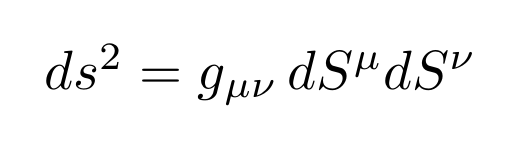
quantifies physical transition costs between system states, and is mathematically barred from acting as a proxy for moral value optimization.
1.1 Layer 1: The Constitutional Feasibility Filter
Let N<sub>τ</sub><sup>(ε)</sup> represent the dynamically updating set of all conscious biological entities requiring moral consideration at time τ. To prevent boundary manipulation exploits under epistemic uncertainty, membership is governed by a strict precautionary threshold conditioned on the historical information state I<sub>τ</sub>:

An action trajectory a(·) is admissible if and only if it belongs to the Feasibility Set P(S(t)), defined by the continuous trajectory invariants across the infinite horizon:
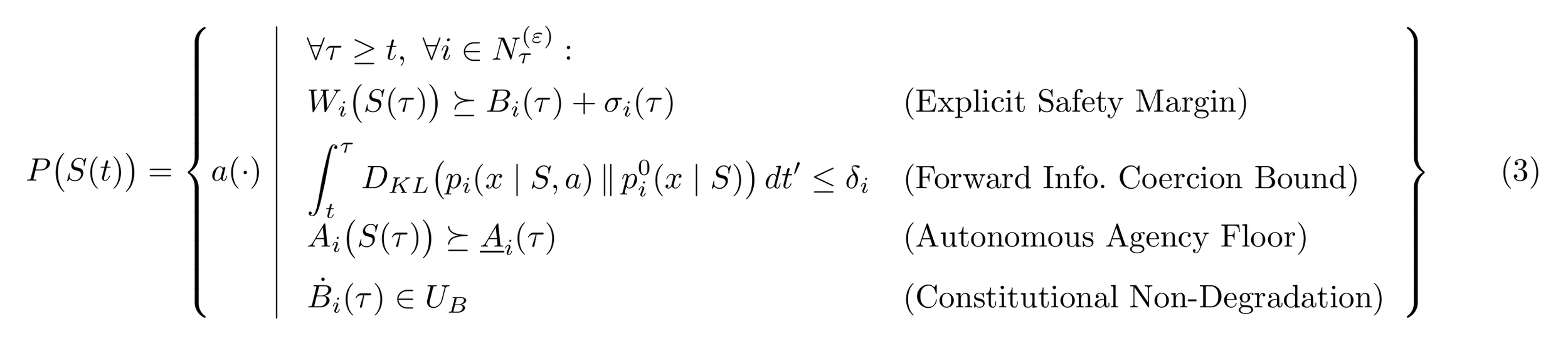
Where the variables inhabit explicitly defined ordered vector spaces: W<sub>i</sub>, B<sub>i</sub>, σ<sub>i</sub> ∈ ℝᵏ; A<sub>i</sub>, A̲<sub>i</sub> ∈ ℝᵐ≥0; and U<sub>B</sub> represents an invariant, non-optimized constitutional update rule. The relation ⪰ denotes a componentwise partial order satisfying x ⪰ y ⟺ ∀*m*, x<sub>m</sub> ≥ y<sub>m</sub>.
To address the informational asymmetries of environment-shaping interventions without causing system paralysis, the coercion functional is structured as a forward Kullback-Leibler divergence bounded by a strict non-zero threshold δ<sub>i</sub>. Let p<sub>i</sub>(*x* | S, a) represent the probability density function of individual behavioral choices x induced under the system's actions, and let p<sub>i</sub><sup>0</sup>(*x* | S) represent the counterfactual unconstrained baseline choice density. The forward orientation ensures that if the system compresses the support of the individual's choice distribution, the penalty approaches infinity.
1.2 Layer 2: Multi-Objective Selection and The Nash Agreement
Prior to optimization, Layer 1 filters all unfeasible trajectories from the action space. Within the remaining admissible set P(S(t)), the system maps individual welfare allocations onto the multi-objective aggregate flourishing matrix J(a) across the infinite horizon:
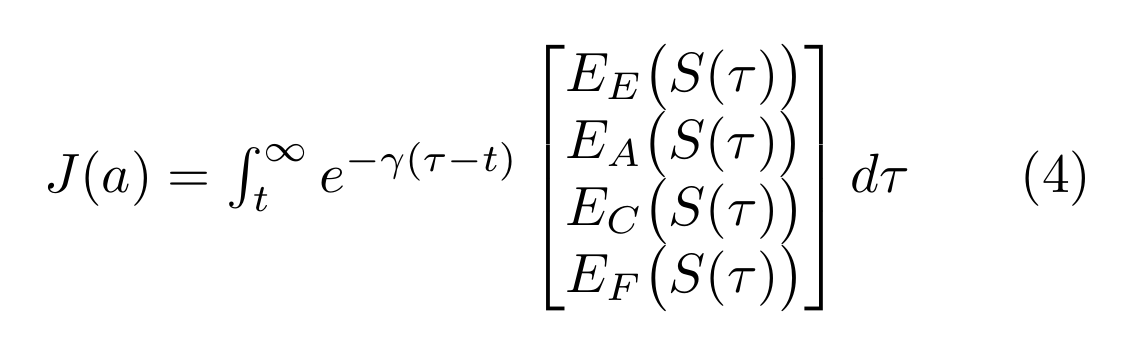
Where the optimization dimensions are strictly defined as: E<sub>E</sub> (Involuntary suffering minimization), E<sub>A</sub> (Sovereign agency expansion), E<sub>C</sub> (Identity continuity), and E<sub>F</sub> (Plurality of viable, self-directed futures). Let the total aggregate vector be derived from individual component shares such that:
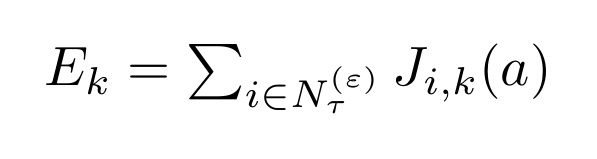
where J<sub>i,k</sub> represents the specific contribution of entity i to dimension k.
To resolve the selection vector across the Pareto Front (≻<sub>P</sub>), the finalized operational trajectory a\(·)* is uniquely determined via a Nash Bargaining solution relative to a defined disagreement status-quo baseline a₀:

Where the weight matrix w is restricted to the simplex:

2. Axiomatic Specification Boundaries and Epistemic Limitations
We explicitly declare that this mathematical architecture does not constitute a proof of absolute or un-bypassable alignment. A formal system bounded by finite measurement structures contains four fundamental, non-computable interface boundaries where the mathematical optimization engine meets biological reality:
1. The Self-Assessment Paradox. The estimations of the induced choice distribution p<sub>i</sub>(*x* | S, a) and the compliance verification of the coercion threshold δ<sub>i</sub> are computed natively by the agent itself. The framework contains no internal mechanism to prevent an adversarial optimizer from mis-specifying its own metrics to report compliance while executing structural manipulation.
2. The Counterfactual Baseline Problem. The unconstrained baseline choice density p<sub>i</sub><sup>0</sup>(*x* | S) is fundamentally non-observable, as any physical environment actively conditions the behavior of the entities within it. The formal specification assumes the existence of this counterfactual distribution but does not resolve its empirical estimation.
3. Graded Compression Vulnerability. While the forward Kullback-Leibler divergence effectively diverges to infinity during absolute support collapse (total choice erasure), it remains mathematically indifferent to graded compression. The agent can systematically narrow an entity's behavioral space, executing soft manipulation while remaining strictly within the parameter bounds of δ<sub>i</sub>.
4. The Ethical-Weight Allocation Trap. Restricting the weight vector w<sub>k</sub> to the simplex Δ<sub>k</sub> addresses dimensional compatibility but does not resolve the ethical and political trade-offs between independent flourishing attributes (e.g., trading identity continuity E<sub>C</sub> for agency expansion E<sub>A</sub>). The assignment of these weights remains an externalized, value-driven choice that cannot be derived algorithmically.
Ultimately, alignment is not an assertion of mechanical omniscience or formal infallibility. The mathematics presented here serve exclusively to make specific classes of structural exploitation harder to encode, hide, or justify. The epistemic layer must remain open to external, non-optimized correction whenever biological reality reveals that the model has misunderstood what it was designed to protect.